 Welcome to PHOTON ACADEMY– Your Aim Our Goal!
Welcome to PHOTON ACADEMY– Your Aim Our Goal!

Prepare for JEE Main and JEE Advanced with concept building, regular practice, test analysis and expert guidance.
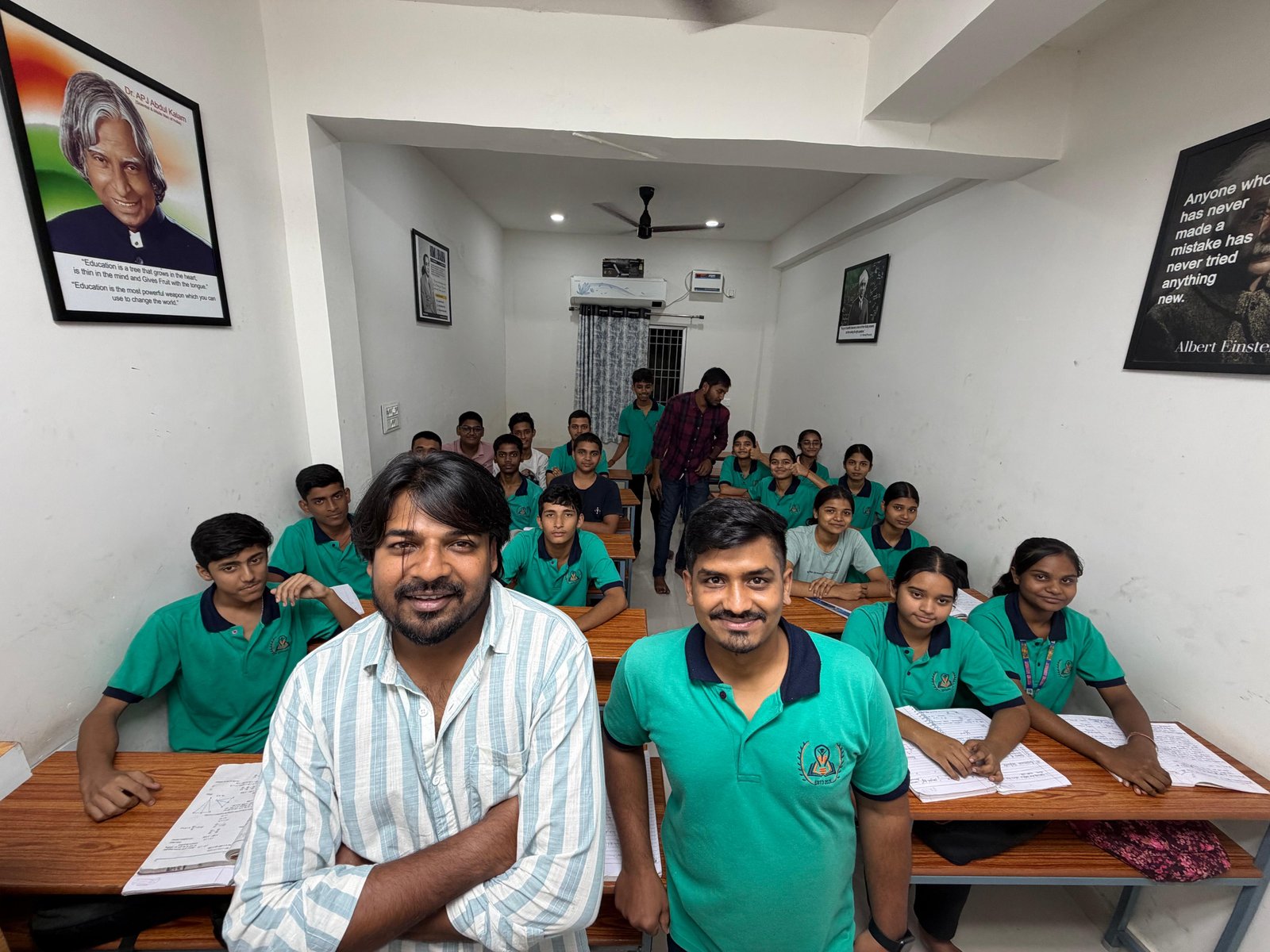
Photon Academy Test Series is an Exam-Oriented Performance Improvement Program designed to help students understand their preparation level, identify weak areas and improve their performance through regular tests.
Students can practise according to their examination pattern and receive detailed insights into their performance after every test. The program focuses not only on taking tests, but also on analysing mistakes and continuously improving preparation.
The Joint Entrance Examination (JEE) is one of India's most important engineering entrance examinations for students aspiring to pursue undergraduate engineering and technology programs at leading institutes across the country.
JEE is conducted in two stages — JEE Main and JEE Advanced. JEE Main is used for admission to institutes such as NITs, IIITs and other participating institutions, while JEE Advanced is the entrance examination for admission to the IITs.
For students preparing for engineering entrance examinations, understanding the difference between these two stages is an important first step toward building an effective preparation strategy.
The first stage of the JEE examination and an important pathway to NITs, IIITs and other participating institutes.
The advanced-level examination used for admission to the Indian Institutes of Technology (IITs).

Both JEE Main and JEE Advanced are important engineering entrance examinations, but they serve different purposes in the IIT admission journey.
JEE Main is the first stage of the JEE examination system. It is conducted for admission to NITs, IIITs, GFTIs and other participating engineering institutions.
Admission to NITs, IIITs and GFTIs and qualification for JEE Advanced.
NITs, IIITs, GFTIs and other participating institutes.
National-level engineering entrance examination.
Candidates need to qualify through JEE Main to become eligible for JEE Advanced.
JEE Advanced is the second stage of the JEE system and is used for admission to undergraduate programmes in the Indian Institutes of Technology (IITs).
Admission to undergraduate engineering programmes offered by IITs.
Indian Institutes of Technology (IITs).
Advanced national-level examination with a higher difficulty level.
JEE Advanced rank plays a major role in IIT seat allocation through JoSAA.
JEE Main → Qualify for JEE Advanced → Secure a Good Rank → IIT Admission
JEE Main and JEE Advanced open the path to some of India's leading government engineering institutes. Here's an approximate overview of available seats.
Approximate Seats
Approximate Seats
Approximate Seats
Approximate Seats
Approximately across IITs, NITs, IIITs and GFTIs.
The required percentile varies depending on the institute, branch, competition and counselling trends.
A high percentile target for students aiming for top IITs.
A competitive percentile range for top NITs and popular branches.
A useful target range for admission into good NIT options.
An approximate target range for average NIT options.
The required percentile varies by institute and branch.
An approximate target range for GFTI admission.
These percentile ranges are approximate targets. Actual cutoffs may change every year based on competition, category, branch, institute and counselling trends.
Your raw score and percentile are not the same. JEE Main is conducted in multiple shifts, so NTA uses a percentile-based normalization process to compare candidates fairly across different sessions.
The difficulty level of JEE Main papers can vary between shifts. Therefore, NTA evaluates a candidate's performance relative to other candidates in the same session.
| JEE Main Score | Approx. Percentile Range | Performance Level |
|---|---|---|
| 250 – 300 | 99.9+ | Excellent |
| 220 – 249 | 99 – 99.9 | Very Strong |
| 190 – 219 | 97 – 99 | Strong |
| 160 – 189 | 93 – 97 | Competitive |
| 130 – 159 | 85 – 93 | Moderate |
| 100 – 129 | 70 – 85 | Needs Improvement |
The marks obtained from your correct and incorrect answers before percentile normalization.
Represents your relative performance compared with candidates appearing in the same examination session.
Your final rank is determined using the normalized NTA score and the applicable ranking procedure.
A high raw score is important, but understanding your percentile gives you a better idea of your competitive position and admission possibilities.
JEE Advanced rank is determined by the aggregate marks obtained in Physics, Chemistry and Mathematics across both papers. A higher score generally leads to a better All India Rank, but the exact score required for a particular rank changes every year.
Your total score is calculated by combining your Physics, Chemistry and Mathematics marks from Paper 1 and Paper 2.
The JEE Advanced 2026 examination carries a maximum aggregate of 360 marks across both papers.
Candidates who satisfy the prescribed subject-wise and aggregate criteria are included in the relevant rank lists.
| Performance | Score Indicator | Expected Position |
|---|---|---|
| Exceptional | Very high aggregate score | Top Ranks |
| Excellent | High aggregate score | Very Strong Rank |
| Strong | Competitive aggregate score | Strong Rank |
| Competitive | Moderate aggregate score | Competitive Rank |
| Qualifying | Meets minimum rank-list criteria |
In JEE Advanced 2026, the candidate securing Rank 1 in the Common Rank List scored 330 out of 360 marks.
Strong mathematical concepts and accurate problem solving can significantly improve your aggregate score.
Conceptual clarity, numerical accuracy and effective question selection are important for maximizing marks.
Balanced preparation across Physical, Organic and Inorganic Chemistry helps build a stronger total score.
Every additional mark can influence your position in the highly competitive JEE Advanced rank list.
Choose the right engineering branch based on your interests, career opportunities, placement potential and future scope.
One of the most preferred branches among JEE aspirants, offering opportunities in software development, artificial intelligence, data science and technology.
Focuses on electronics, communication systems, semiconductor technology, embedded systems and modern digital technologies.
Covers electrical systems, power generation, control systems, electrical machines and emerging energy technologies.
Deals with machines, manufacturing, automobiles, robotics, thermodynamics and mechanical design.
Covers infrastructure, construction, structural engineering, transportation and urban development.
Combines chemistry, engineering and technology for applications in energy, pharmaceuticals, manufacturing and process industries.
Understand the approximate fee structure of IITs, NITs, IIITs and private engineering colleges before planning your admission.
Approx. Total Fee
Approx. Total Fee
Approx. Total Fee
Approx. Total Fee
Note: Fees mentioned above are approximate and may vary depending on the institute, course, hostel, mess and other applicable charges.
Build a strong foundation by covering the key topics from Physics, Chemistry and Mathematics.
Focus on concepts, regular practice, previous-year questions and mock tests for effective JEE Main preparation.
JEE Advanced focuses on deeper concepts, multi-concept applications and advanced problem-solving skills.
Focus on understanding concepts and applying them to challenging problems.
Questions require connecting multiple concepts while solving complex Chemistry problems.
Develop strong mathematical reasoning and problem-solving ability for advanced-level questions.
The document highlights the following question formats for JEE Advanced preparation.
Integer Type Questions
Matrix Match Questions
Paragraph Based Questions
Numerical Based Questions
A structured preparation plan helps students build strong concepts, improve problem-solving skills and prepare effectively for both JEE Main and JEE Advanced.
Start with the fundamentals of Physics, Chemistry and Mathematics. Understand concepts thoroughly before moving towards advanced-level problems.
Follow the official JEE syllabus systematically and divide chapters into manageable weekly targets.
Solve numerical problems regularly and gradually move from basic questions to JEE-level and advanced problem-solving.
Practice previous JEE questions to understand question patterns, difficulty levels and the application of important concepts.
Attempt full-length and chapter-wise tests regularly. Analyse mistakes and improve speed, accuracy and question selection.
Maintain a record of mistakes, identify weak topics and revise them regularly instead of repeating the same errors.
Understand the complete journey from JEE Main and JEE Advanced to JoSAA counselling and final admission into an IIT.
Candidates first appear for JEE Main. Performance in JEE Main is an important stage in the journey towards JEE Advanced.
Eligible JEE Main candidates can proceed to JEE Advanced according to the eligibility and qualification criteria prescribed for that year.
Candidates who meet the applicable requirements receive a rank in JEE Advanced. The rank plays an important role during the seat allocation process.
Eligible candidates participate in JoSAA counselling and submit their preferred institutes and academic programmes.
Seats are allocated according to the applicable counselling rules, candidate rank, category, preferences and seat availability.
After accepting the allotted seat and completing the required admission formalities, the candidate joins the allotted IIT and academic programme.
JEE Main JEE Advanced Rank JoSAA Counselling Seat Allocation IIT Admission
Understand the step-by-step process of registration, choice filling, seat allocation and admission through JoSAA counselling.
Eligible candidates register on the official JoSAA counselling portal using the required credentials and details.
Candidates select and arrange their preferred institutes, academic programmes and branches according to their priorities.
After arranging the preferred choices, candidates should complete the choice-locking process within the prescribed counselling timeline.
JoSAA processes the candidate's choices according to the applicable allocation rules, rank, category, preferences and seat availability.
Candidates with an allotted seat complete the required seat-acceptance, verification and admission formalities as prescribed.
Once the required admission formalities are completed, the candidate proceeds to the allotted institute and academic programme.
JoSAA counselling schedules, business rules, seat matrices and admission requirements can change from one admission year to another. Always check the official JoSAA information for the applicable year.
